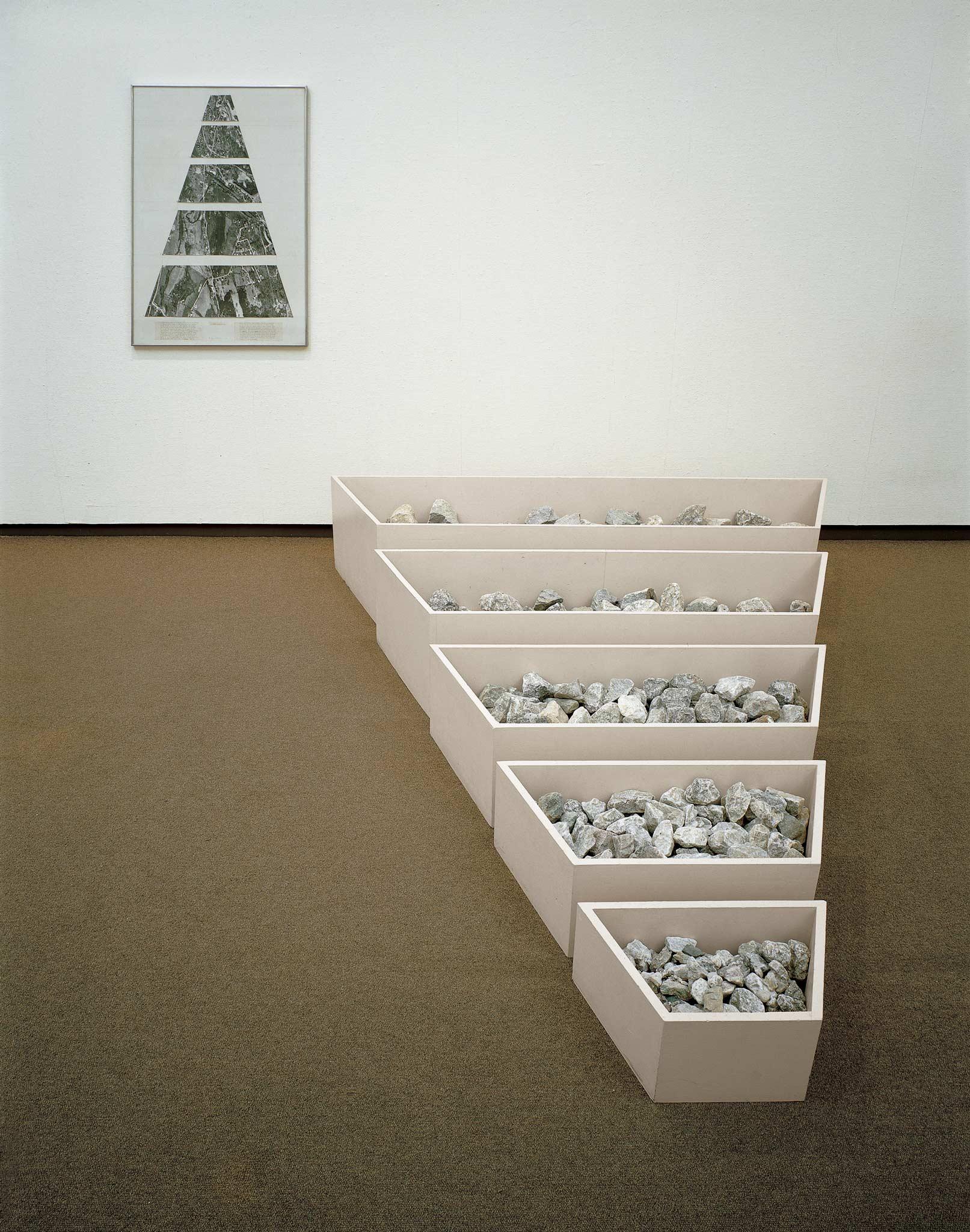
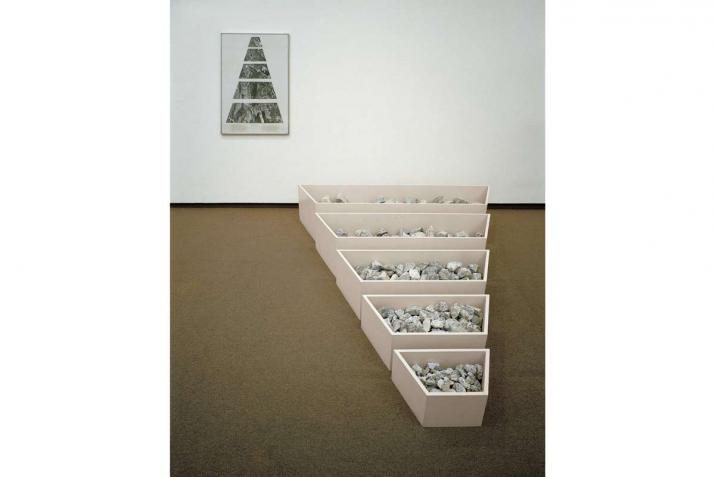
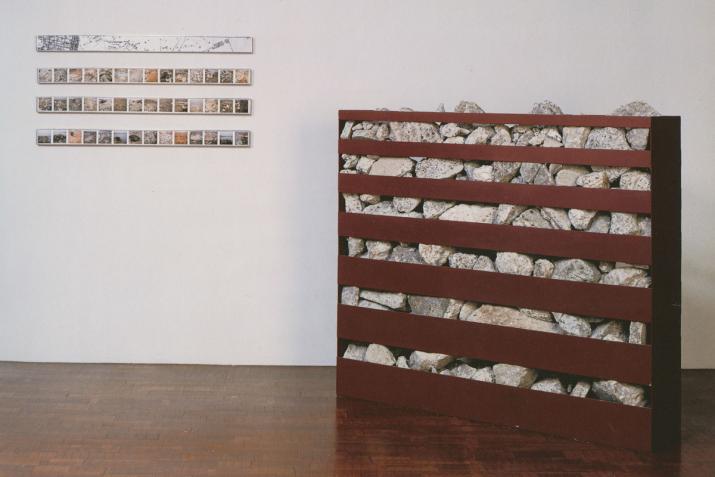
Painted wooden bins, limestone, gelatin silver prints, and typescript on paper with graphite and transfer letters, and mounted on mat board
Bins installed:16 ½ × 82 ¼ × 103 in. (41.9 × 208.9 × 261.6 cm); framed: 40 ¾ × 30 ¾ × 1 in. (103.5 × 78.1 × 2.5 cm); sheet: 39 7/8 × 29 7/8 in. (101.3 × 75.9 cm)
Collection: Museum of Contemporary Art Chicago, Gift of Susan and Lewis Manilow
© Holt/Smithson Foundation / Licensed by Artists Rights Society, New York
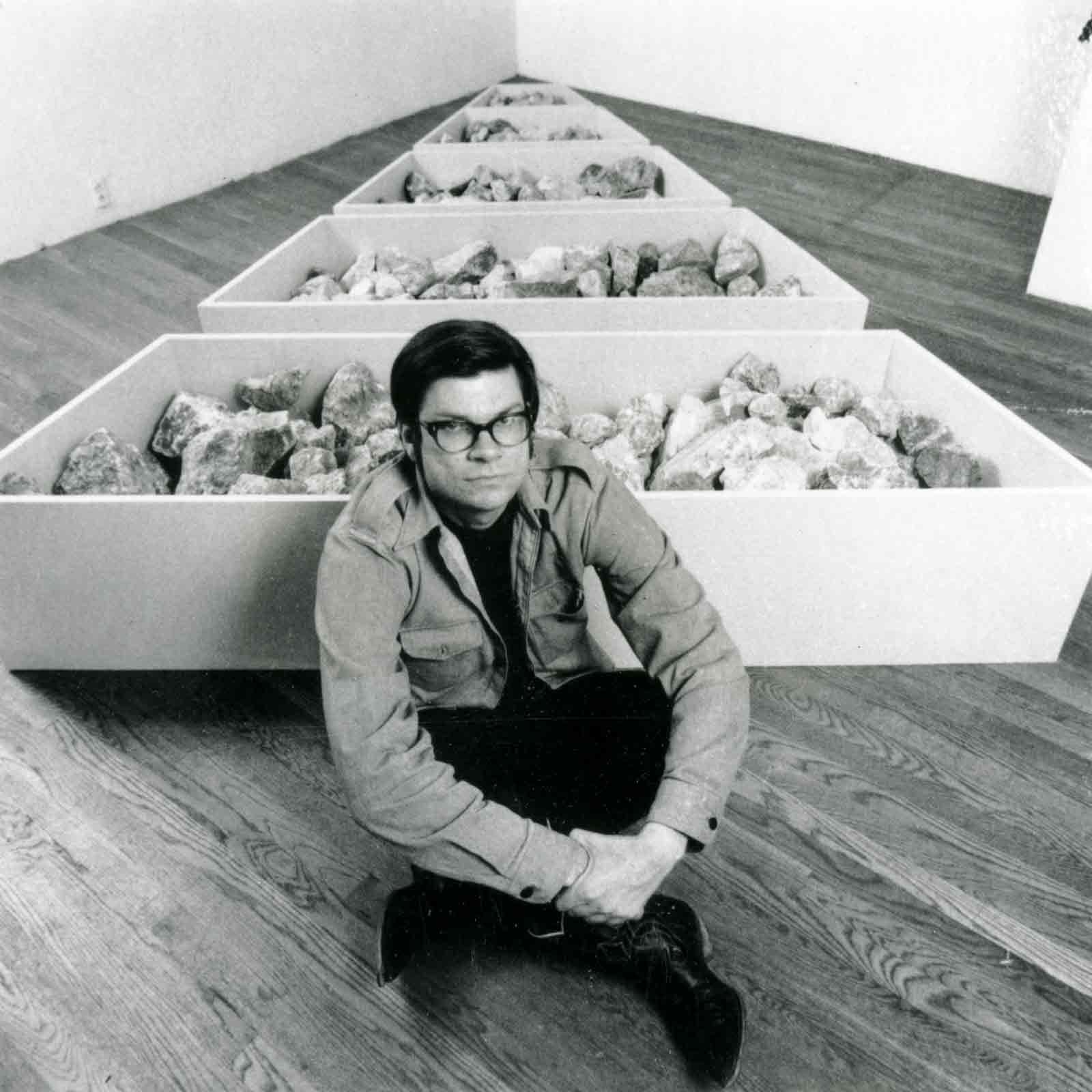
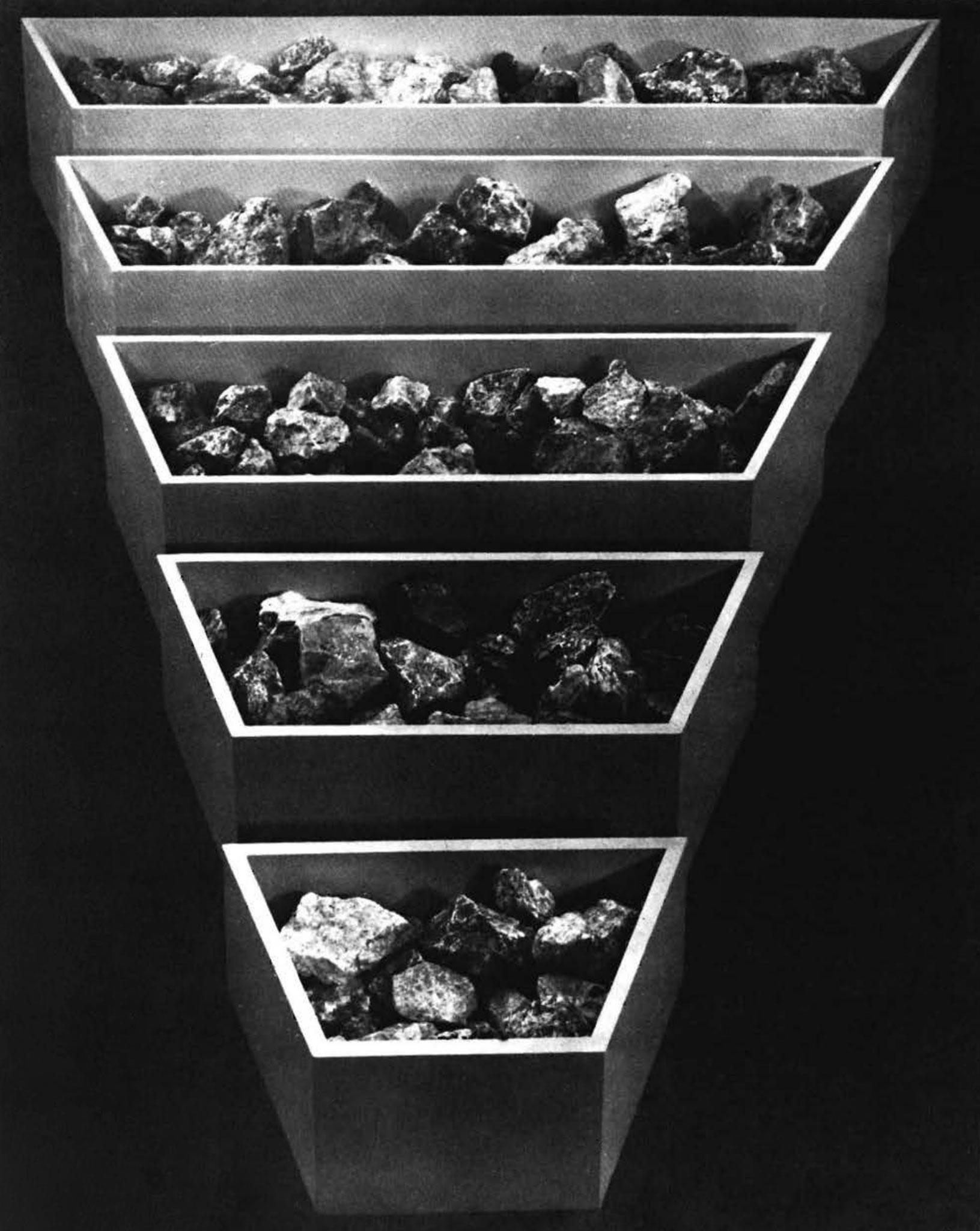
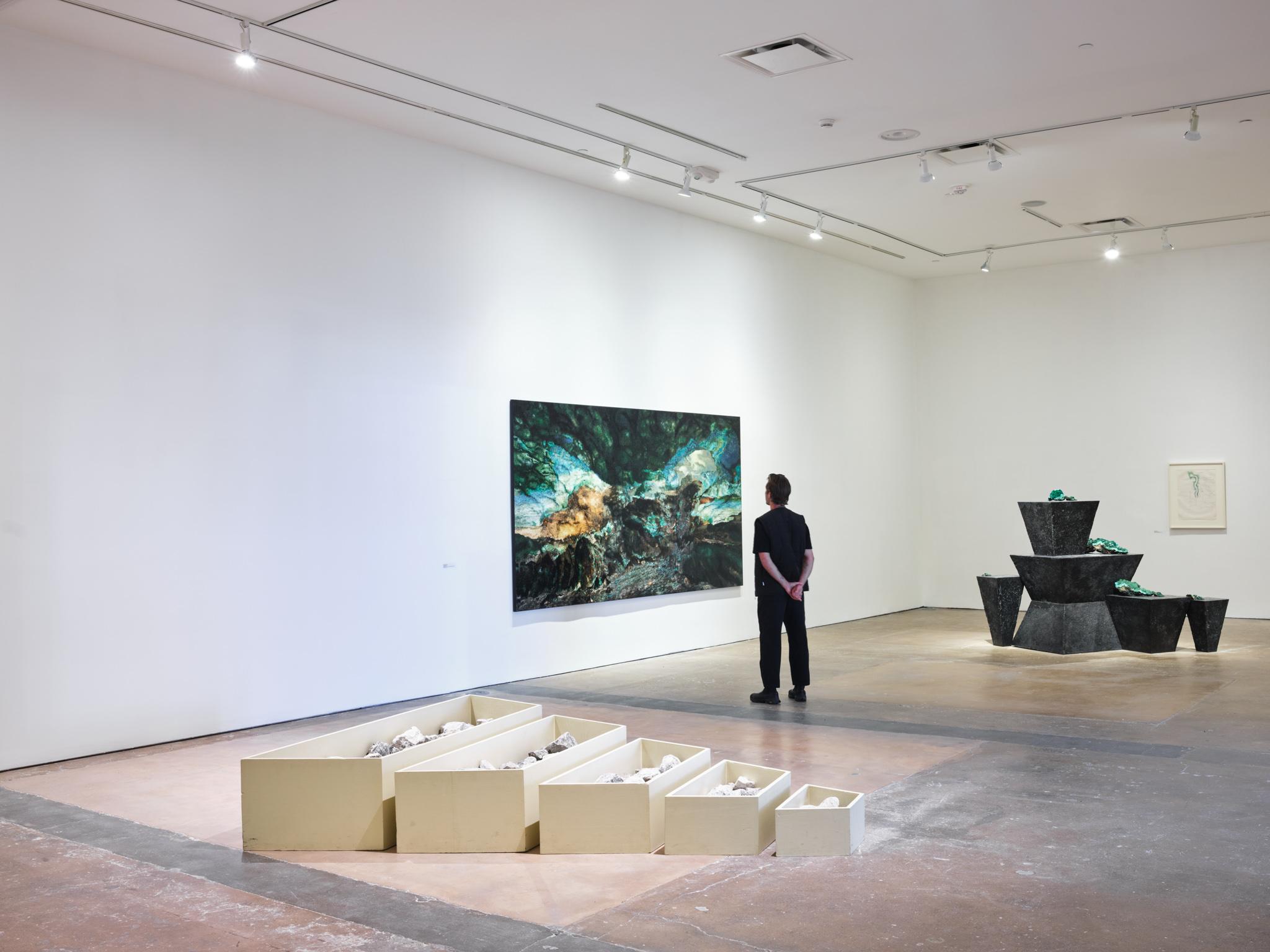
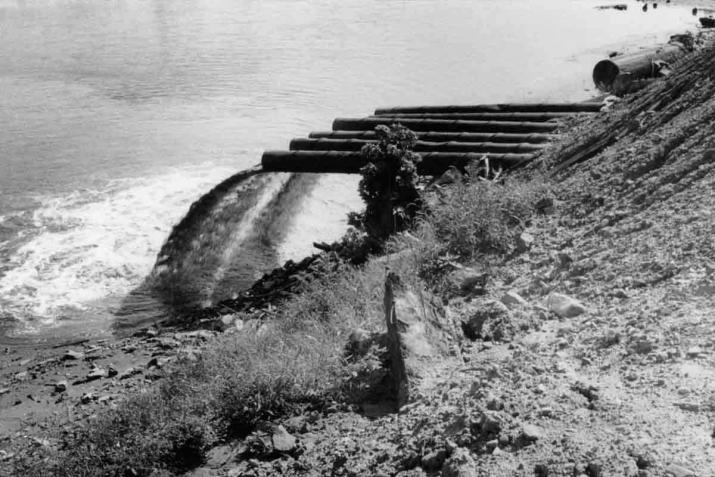
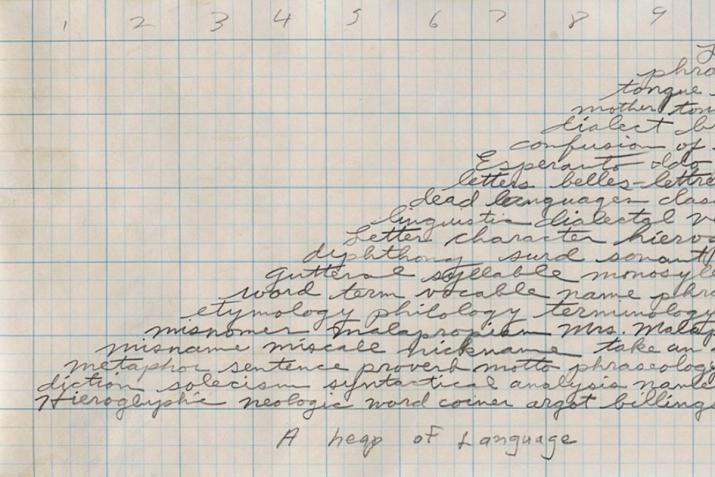
In 1968, Smithson began creating what he called Nonsites, sculptures he described as “material maps” that brought geological material from a specific site into the Nonsite of the museum. He was interested in the lack of dialogue between the museum and its surrounding contexts and sought to rebuild that connection. This Nonsite points to a former quarry in Franklin, New Jersey. The rocks held in these five bins were sourced from this location. If they were to be viewed under the light of a mercury vapor lamp, they would glow red or green due to the presence of the minerals calcite and willemite. New Jersey, where Smithson grew up, frequently appears in his work, a geographical location that the art world of his time regarded as an “elsewhere” to the “there” of New York City. The map on the wall marks the five outdoor locations where the stones were gathered, and the accompanying text indicates that tours of the Franklin site are available on request. He also notes that an aerial photograph of the exact point where the 70° perspective lines on the map converge is stored in a security deposit box, inviting visitors to request to view it. Smithson was interested in how the ideas of “here” and “elsewhere” are constructed. The elsewhere could be New Jersey, the museum, or a photograph; for Smithson, it was the relations between them that mattered most.