Video, black and white, sound
Duration 30 minutes, 57 seconds
Collection Holt/Smithson Foundation
© Holt/Smithson Foundation / Licensed by Artists Rights Society, New York. Distributed by Electronic Arts Intermix, New York
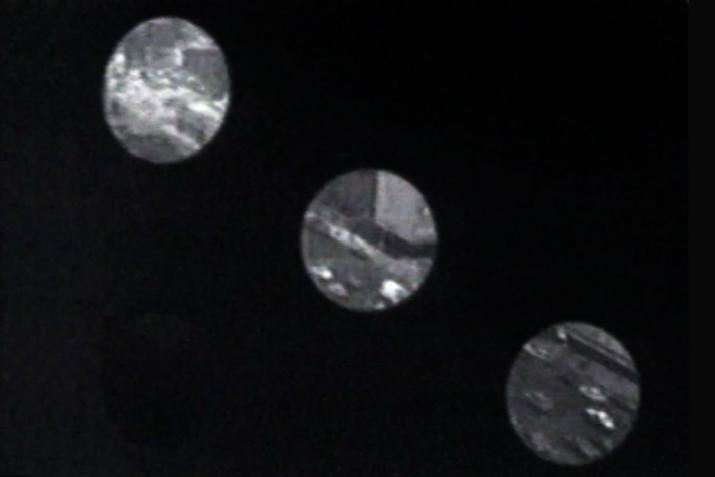
Zeroing In is an early video experiment by Nancy Holt. In this just over a half hour video, filmed from an apartment in Kips Bay Towers on the east side of Manhattan. Holt and the experimental novelist and critic Ted Castle visually explore the urban landscape of New York City. The pair view a recording of a New York City street intersection, made with a wide-angle view, looking down from the window of a high-rise building. Two props are involved: a cylindrical tube and a black piece of board, from which five circular, and closable, peepholes were cut. These obstacles are placed between the camera and the vista to reveal different sections of the view.
Persistently Holt asks, “what do you see?” Holt and Castle discuss their visual and cognitive perceptions, attempting to suspend identification of what they see, struggling against the instinctual urge to categorize and label. As objects are alternately obscured and identified, disoriented and located, a rich dialogue emerges on ideas of viewership, identity, cognition and experience.