Nancy Holt’s "Western Graveyards:" The Comstock Lode, Ichthyosaurs, Land Art, and Nevada’s Legacy of Memory
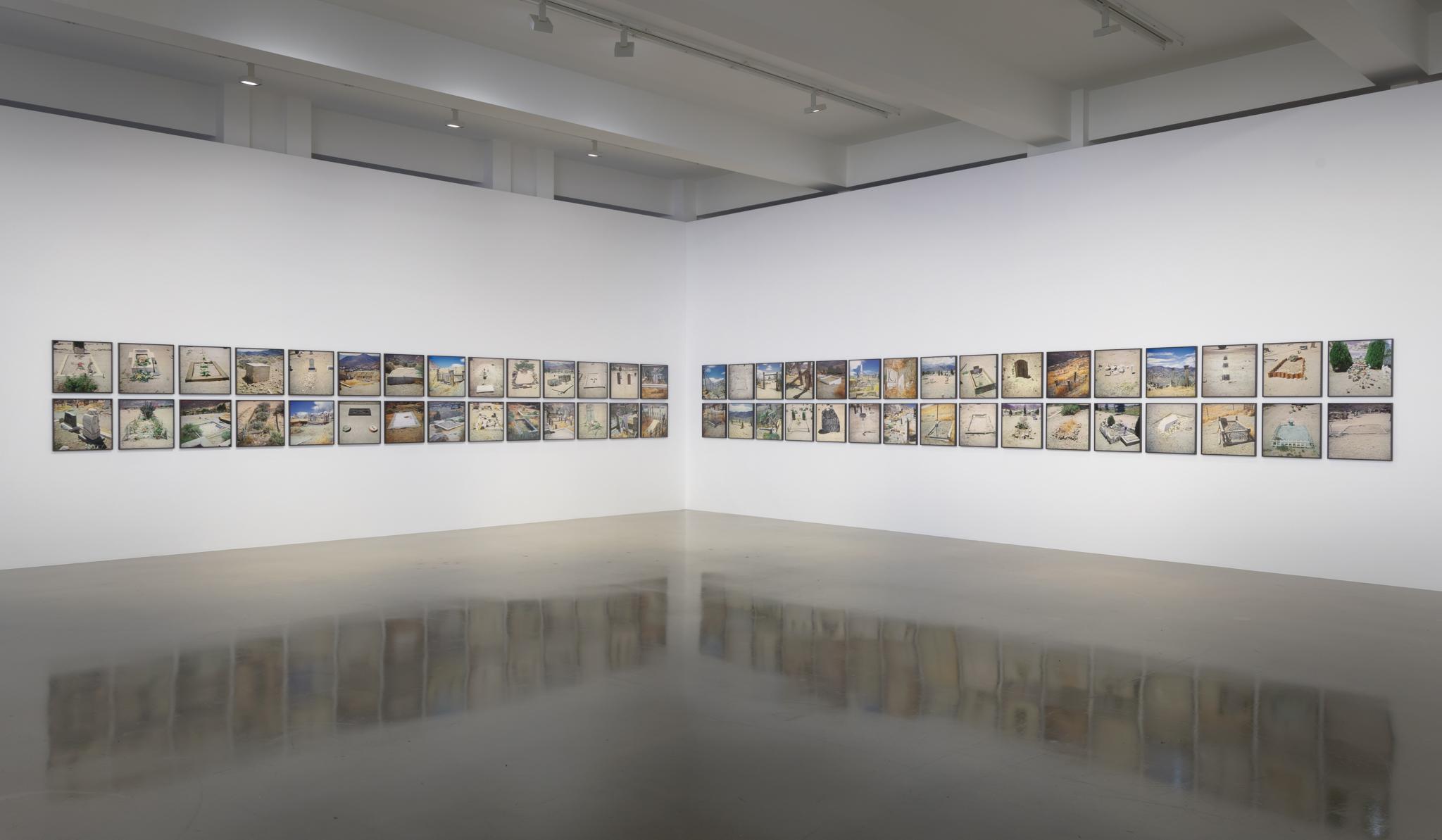
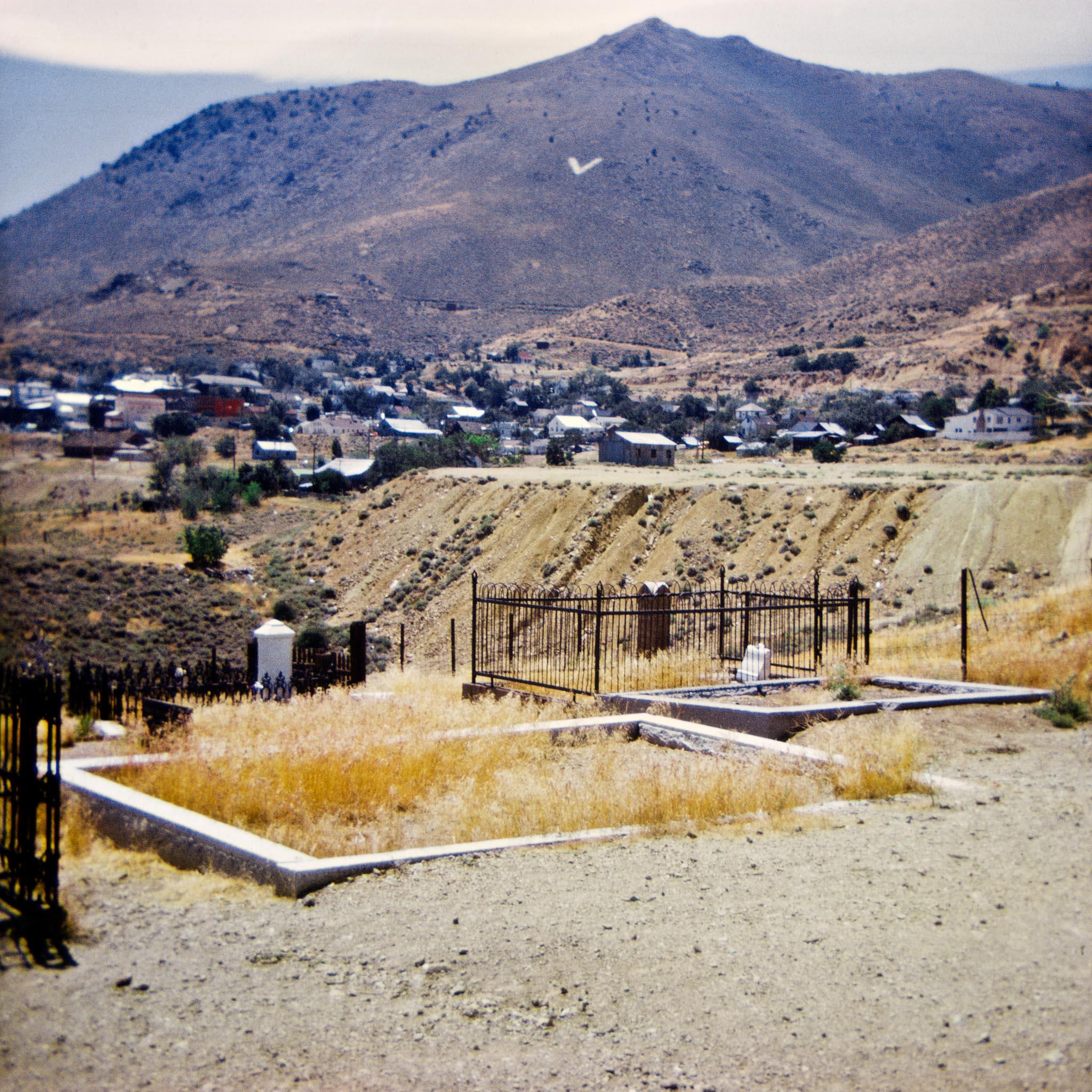
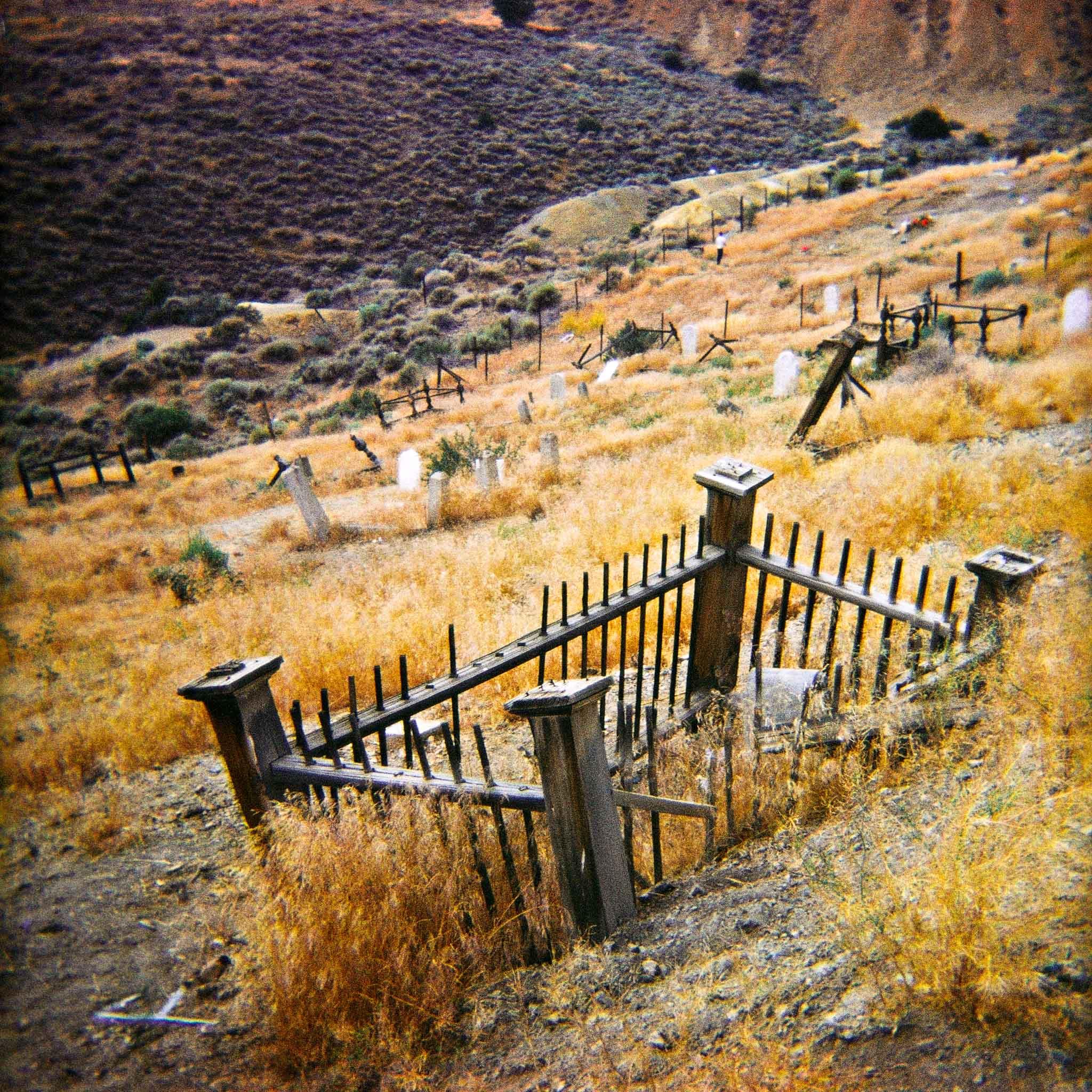
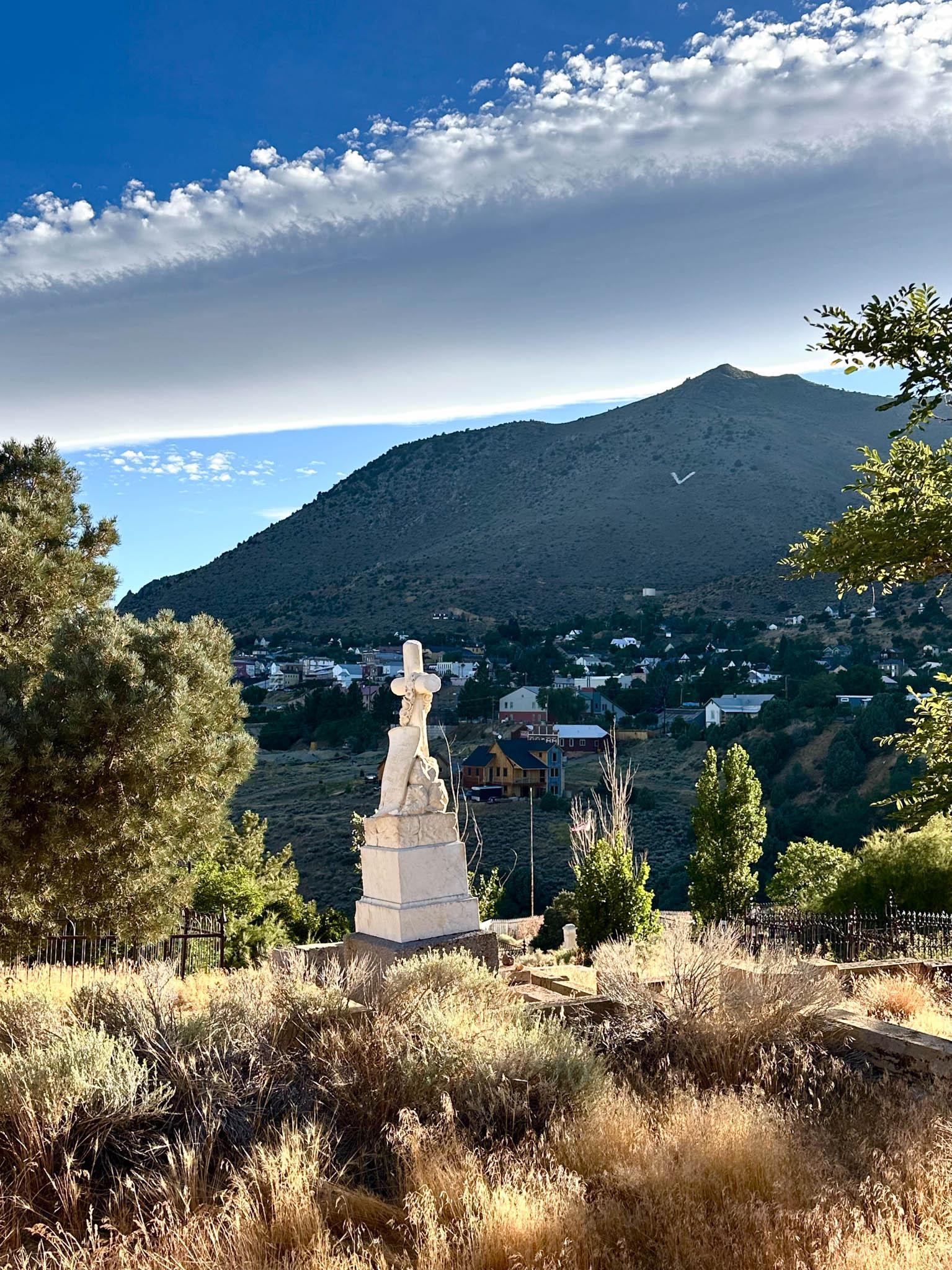
Nancy Holt’s Western Graveyards (1968)1 is a photographic series that preserves the visual record of cemeteries tied to those who lived and labored during the Comstock Lode's peak2 in Virginia City, Nevada, and of former residents in Lone Pine, California.3 Captured in the late 1960s at the birth of the Land art movement,4 Holt’s Western Graveyards consists of sixty archival prints from an original 126 film transparencies taken during her first visit to the American West,5 accompanied by fellow artists Robert Smithson and Michael Heizer. Virginia City is not a place to visit by chance, but rather a destination to experience with intention. The golden grasses and scattered pinyon pines6 surrounding decaying markers speak to the entanglement of mortal ambition with the persistent cycles of nature. Reaching Virginia City requires ascending the Geiger Grade7 —the first highway built in Nevada—a serpentine road that mirrors the precarious ascent of those who once mined its depths. These sites reveal the entropic logic of settler capitalism, where grave markers serve as silent witnesses linking individual lives to the broader arc of industrial expansion, decline, and the dismantling of ancient land. In Holt’s images, I am drawn less to what remains than to what is missing—those sanctioned contours of historical visibility.
My interest as an artist and researcher lies in the convergence of regional narratives and the often-overlooked complexities within them—particularly in the underrecognized yet charged terrain of Nevada, my home state. Once part of Mexico, Nevada was forged into statehood in 1864 through Unionist strategy under President Abraham Lincoln during the Civil War.8 Long before the formation of contemporary nations, the Indigenous communities of this region, among the most historically documented in the world, shaped the land’s narratives. Against these histories, Nancy Holt’s Western Graveyards became the catalyst to examine the variegated layers of Nevada’s complexity. As an artist, writer, and musician, I am drawn to Holt’s multidisciplinary approach and to the way she moved fluidly across forms—an ethos that resonates with my own practice. When I first encountered her work, I wrestled with whether her photographs functioned as documentary records or as art-historicized tourist images, made significant only by Holt’s name and institutional validation. I questioned whether the works themselves held power or merely reflected power projected onto them. Over time, I realized that had Holt not photographed my state, I might never have explored its cultural wealth with such fervor. Her work brought me back to Reno with renewed clarity, where I have since become deeply engaged with the Nevada State Museum, Nevada Museum of Art, Artown, the University of Nevada, Truckee Meadows Community College, and the local community of artists, youths, and civic leaders.
As a native Nevadan, born in 1995 and raised in Reno, my childhood connection to Virginia City began with family adventures that nurtured a lifelong fascination with its layered past. It is perhaps no coincidence that Nancy Holt visited this same place in a time when few artists from New York,9 ventured so far west. Growing up, we spent weekends metal detecting for antique coins and arrowheads, hiking to the iconic “V” on Mount Davidson—towering 7,865 feet above the town10 —and riding the V&T Railway to nearby Carson City, Nevada’s state capital. School field trips to landmarks like the Fourth Ward School and the Chollar Mine, deepened this sense of place, fostering an early reverence for the mythologized legacy of Western settlers. Mexican and Chinese immigrants,11 the Northern Paiute (Numu),12 and Washoe (Wašiw)13 peoples were central in shaping the region’s development. These communities built railroads, sustained economies, and stewarded these ancient lands long before the extractive economies of industrialization took hold. Still, their histories remain largely absent from dominant narratives—relegated to the margins or reduced to footnotes in Nevada’s story.14
Growing up in Reno, I was taught to take pride in the idea that a small town near my home had shaped world history. Years later, in 2023, encountering Holt’s Western Graveyards in the exhibition Locating Perception at Sprüth Magers in Los Angeles15 unmoored that inherited framing. To see Virginia City—so familiar, so personal—pedestaled within a major blue-chip gallery was not a confirmation of pride but an invitation to inquiry. Holt’s photographs revealed the cemetery not through wistfulness or sentimentality, but with a quiet, solemn astonishment, where headstones and fence lines spoke less of economic triumph and more of human lives slipping toward obscurity.
Using color film, Holt methodically documented these burial grounds,16 attuned to subtle tonal shifts that register the lingering traces of Nevada’s frontier legacy, and its exclusions, most notably within the Silver Terrace Cemeteries of Virginia City17 and its surrounding areas. Weather-worn wood and stone graves, Italian marble tombs, and forgotten names evoke an era when economic prosperity, mortality, classism, and cultural vitality were inextricably bound. Through these images, Holt constructs a nuanced meditation on human and ecological cycles, illuminating silence, dissonance, and the contested memories embedded in U.S. expansion.
Before Nevada’s statehood in 1864, the Great Basin and Eastern Sierra regions were home to the Washoe, Northern Paiute, Western Shoshone (Newe), and Southern Paiute (Nuwuvi)—sovereign nations largely erased from mainstream narratives of the American West.18 The Washoe are the original stewards of the Lake Tahoe Basin, a site of profound cultural and ecological significance. Their seasonal migrations, ascending to the Sierra Nevada alpine lakes in summer and descending to the valleys in winter, sustained a reciprocal relationship with the land for millennia. With the discovery of the Comstock Lode in 1859 and the rise of Virginia City as a mining boomtown, this homeland was overtaken by extractive industry. Logging operations razed forests to fuel the silver boom, settler expansion fractured traditional life, and Washoe communities were displaced to the margins. Today, despite their ancestral bond with Lake Tahoe, the Washoe hold no title to its shores.19
Holt’s exploration of ecological, celestial, and societal systems offers a lens for understanding time and memory. The Comstock Lode transformed Virginia City into a major mining hub, drawing diverse, racially segregated communities, yet fostering a distinctive Victorian-era cultural life. Institutions such as Piper’s Opera House hosted performances and public gatherings, while writers like Artemus Ward,20 Mark Twain, and Dan DeQuille helped define early American literary humor through the Territorial Enterprise.21 The Comstock’s influence extended beyond Virginia City, fueling the rise of nearby Reno and helping to revitalize San Francisco’s economy after the 1857 financial depression. Yet this prosperity was inseparable from displacement and exploitation: a reminder that cultural flourishing often rests upon systemic erasure.
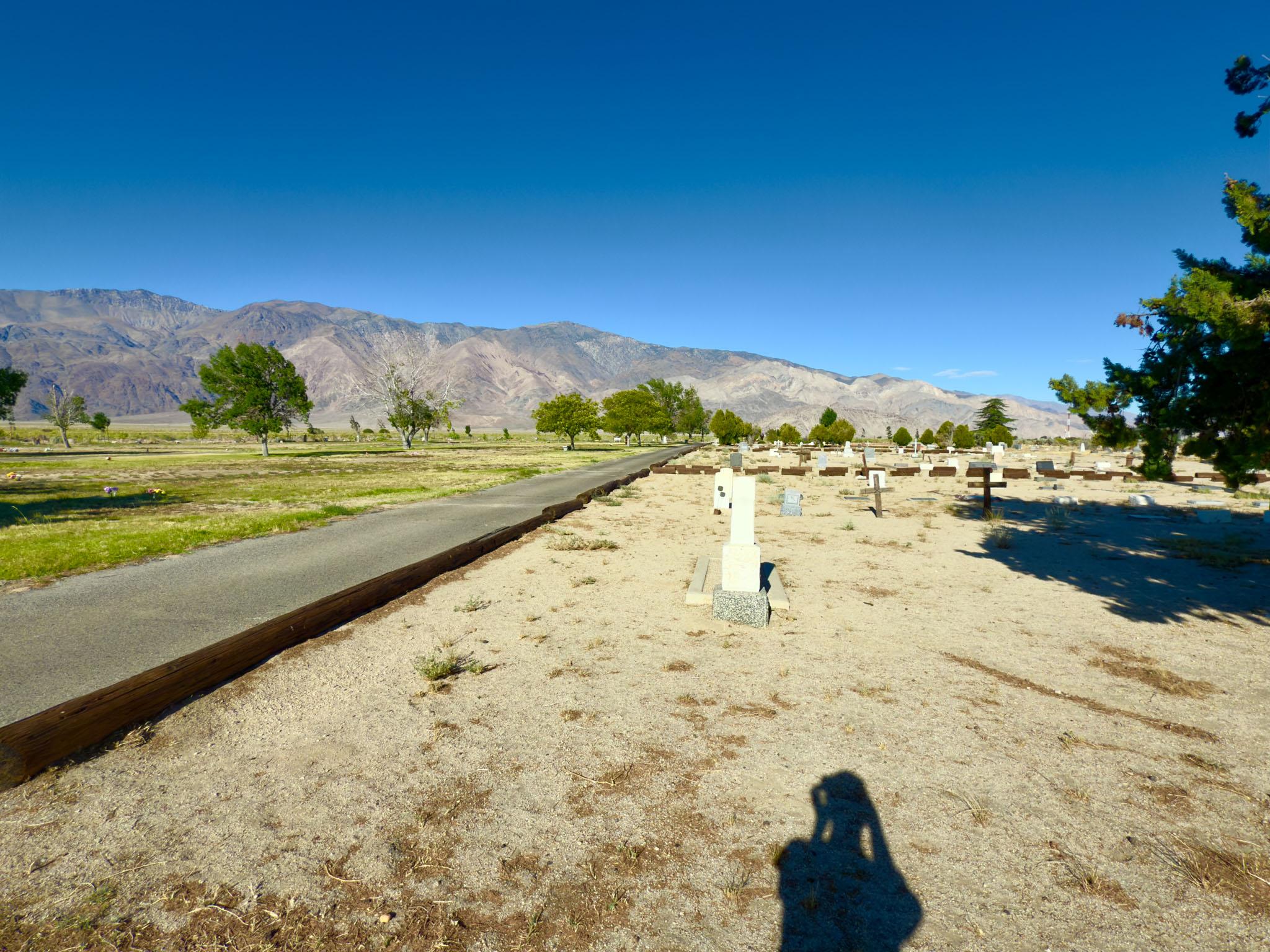
While this essay centers on Virginia City, Lone Pine emerges as its necessary counterpoint. Virginia City belongs to my childhood experience; Lone Pine to my adult life as a frequent traveler between Los Angeles and Reno along U.S. Route 395. Long mythologized through its role in classic Western cinema, the region helped shape the visual vocabulary of the American “frontier.” Just north lies Manzanar22 —one of ten World War II incarceration camps where more than 10,000 Japanese Americans, many of them U.S. citizens, were unjustly detained by the federal government. The site resonates uneasily with the present, recalling the migrant detention centers that line the U.S.–Mexico border—reminders that cycles of incarceration and racialized exclusion are not confined to the past. As a first-generation American with Colombian and Mexican roots, this continuity carries particular weight: the same structures of exclusion that once targeted Japanese Americans continue to haunt Latinx communities today. In photographing the Lone Pine Cemetery, Holt’s frame encompasses a terrain marked by absence, where Paiute irrigation once sustained the Owens Valley. It is also a landscape renamed by Southern-sympathizing prospectors who imposed the name “Alabama Hills” over Payahuunadü.23 The frame may be fixed, but the land remains unsettled, bearing witness to a national narrative built on selective memory. In Holt’s hands, the camera becomes an instrument of quiet reckoning. Her inclusion of Lone Pine reveals the tensions embedded in the Western landscape—where spectacle and suppression, fantasy and violence, often coexist.
These tensions echo in how the West remembers certain figures while erasing others. The settlers who advanced its violent expansion remain prominently commemorated: John C. Frémont and Kit Carson, central players in military campaigns against Native nations, are immortalized in city names, mountain ranges, and monuments. Carson City bears Carson’s name; Frémont’s is etched across maps and curricula. Their legacies are institutionalized, while figures such as James Beckwourth—a controversial Black frontiersman, fur trader, and explorer who forged vital routes through the Sierra—receive little public recognition. Indigenous leaders like Chief Truckee, remembered as a guide and intermediary, and his granddaughter Sarah Winnemucca (Northern Paiute), the first Native American woman to publish a book in English, Life Among the Piutes: Their Wrongs and Claims (1883),24 are commemorated in place names and, in Winnemucca’s case, with a statue in the U.S. Capitol. Yet even these gestures often mediate their legacies through settler narratives rather than fully reckoning with their voices and contributions. The same is true for Louisa Keyser (Dat So La Lee, Washoe), whose baskets, once treated as ethnographic curiosities, are now celebrated in museums as masterpieces of Indigenous artistry. Meanwhile, the broader histories of Indigenous, Black, Asian, and Latinx peoples who shaped Nevada’s development remain marginalized. The mythic “West” persists, a fantasy of heroic conquest and Manifest Destiny rarely pierced by the realities of lived experience.
Even the formation of regional identity is steeped in contradiction. From an early age, Nevada children are taught to celebrate the state’s uniqueness. In second grade, we memorized the state song, “Home Means Nevada,”25 and learned its emblems: the Mountain Bluebird, the Sagebrush, and the Lahontan Cutthroat Trout.26 These symbols, repeated in classrooms and civic events, cultivated a sense of belonging rooted in natural beauty and quiet pride. The Nevada I know is equally defined by vernacular forms of cultural life—seasonal events like Hot August Nights, the Great Reno Balloon Race, and community performances held in local casino ballrooms, spaces often dismissed by outsiders as crass or commercial. For us, they were central, even sacred. Today, areas in Reno such as MidTown and the Riverwalk District have become vibrant havens for the queer community, fostering artistic and communal expression. These everyday moments of belonging are absent from Western Graveyards, which instead builds its narrative through a portrait of stillness, erosion, and neglect. Holt’s photographs do not depict state symbols or scenes of communal celebration; rather, they speak through a visual language of silence. Her work exposes the fragile conditions under which memory is made and unmade, reminding us that history is not only what is preserved but also what quietly disappears—or is deliberately buried.
To understand Nevada is to confront its layered realities: deep time, racial exclusion, extractive grandeur, and everyday resilience. It is a place where ancient homelands are marketed as vacation destinations, and where the violence of colonization lies buried beneath a mythology of freedom. The stories that prevail—of silver mines, pioneers, and wagon trains—remain incomplete without those that have been left out. As Nancy Holt’s Western Graveyards reminds us, to tell a fuller story requires looking beyond the symbols we were taught to memorize and toward the silences we have been conditioned to ignore.
My perspective is shaped by lineage and migration, yet it remains largely invisible within Nevada’s dominant cultural narratives, despite the growing presence of Latinx communities across the state. When I look at Western Graveyards, I encounter two intertwined inheritances: one rooted in childhood memory, the other refined through research. In Holt’s images, I see a crumbling hierarchy, grave markers of those deemed worthy of remembrance. In contrast, others, like the Chinese immigrant communities whose Chinatowns were burned in Reno and Virginia City, are erased from view. Holt was documenting not only burial sites but also the residues of exclusion, the very structures that privileged certain histories while rendering others invisible, the motif of expansion itself.
Holt photographed Western Graveyards at a moment of rising political consciousness. Civil rights protests, anti-war movements, and expanding cultural awareness were reshaping the public sphere—and, by extension, the art world itself. Within Nevada, the desegregation of casinos had occurred only eight years earlier in 1960, driven in part by performers like Sammy Davis Jr.,27 who demanded equal treatment both on and off stage. His career, and Nevada’s fraught relationship to race, unfolded alongside the broader cultural transformations that continue to inform my own work.
One of those markers is The Misfits (1961),28 directed by John Huston and written by Arthur Miller, starring Marilyn Monroe, Clark Gable, and Montgomery Clift. Filmed in Dayton, just down the road from Virginia City, both towns whose Chinatowns had been burned, it coincided with Reno’s Mapes Hotel, where performers such as Liberace29 once appeared in the Sky Room.30 Their presence illuminated the intertwined racial and queer histories embedded in Nevada’s mid-century entertainment culture. Today, only photographs remain—fleeting traces of a shifting cultural landscape. Even photographer Henri Cartier-Bresson, too, attended the film’s press opening, situating this moment within a lineage of photographers drawn to Nevada’s contradictions. Holt’s arrival feels like an extension of that lineage, positioning the state not as peripheral but as a contested stage for American myth-making.
As an artist developing The Mapes Suite—a multidisciplinary project combining a painting series and musical suite that explores Black, queer, Latinx, and Hollywood histories in Nevada—I continue to unravel the aftershocks of these legacies. The Mapes Hotel, demolished in 2000, endures in my imagination as a symbol of mid-century glamour and cultural amnesia. I witnessed its demolition as a child, an experience that made loss both personal and formative. Had I lived in 1950s Nevada, I would not have been allowed inside the Mapes as a Brown person—a truth that deepens my commitment to reclaiming such spaces through art. Through geometric abstraction and orchestral pop, I approach Nevada not as backdrop but as protagonist—both stage and archive.31 In this way, I see my project extending Holt’s legacy, using architecture and landscape not only as formal subjects but as vessels of cultural memory. Where Holt framed history through a documentary lens, rendering place as an archival record, my work reimagines history as embodied, rhythmic, and continually remade.
Holt’s work underscores these systemic entanglements by turning her attention to the overlooked edges of history, capturing graveyards through still, frontal compositions that resist romanticization. Her sensitivity to transitory light and environmental rhythm, more fully developed in later works but already evident here in her attention to entropy, connects earthly sites to larger cosmic frameworks. Before visiting, she may have imagined the West as an abstract possibility, a space of reinvention. Western Graveyards marks the moment when that openness became anchored in place. Through repetition, natural light, and measured framing, she constructs an insistent archive in which migration, economic development, and cultural legacy are embedded not through monumentality but through subtle traces inscribed into the land.
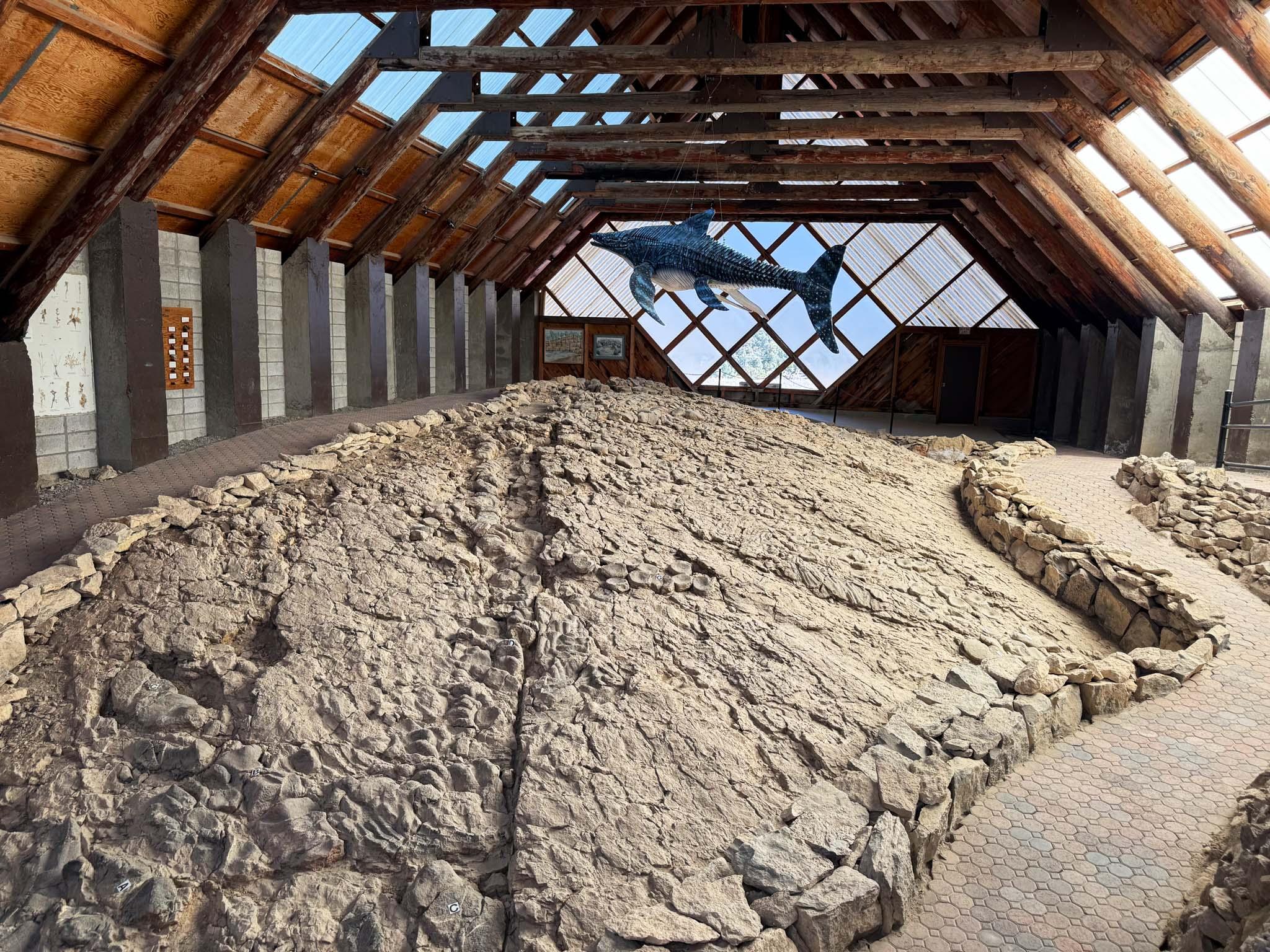
As a photographic series, Western Graveyards occupies the breach between presence and erasure, dwelling in the spectral space between truth and what is permitted to become historicized. Nevada’s state fossil, the ichthyosaur, offers a symbolic counterpoint, an ancient marine presence buried beneath the parched skin of the Great Basin that reminds us how entire eras can slip beneath the surface, unseen and unacknowledged. Although my first encounter with Berlin-Ichthyosaur State Park32 came through the Nevada Museum of Art’s Deep Time: Sea Dragons of Nevada,33 I visited the site in person this year, seeking firsthand experience for this essay. The long drive into central Nevada, cutting through open desert and evolving light, echoed Holt’s ethos of embracing unfamiliar terrains and allowing new experiences to shape perception. Berlin-Ichthyosaur, a mass grave of creatures that swam in Nevada’s Triassic seas more than 250 million years ago, provides insight into prehistoric ecosystems. The fossil bed represents another kind of graveyard—one that predates human memory entirely.
Holt’s work invites us to consider how one might come to know a place without physically being there: how attention, imagination, and layered narratives can produce a form of remote intimacy. This echoes her early engagement with site-specificity and the ways she secured land for her large-scale sculptures, often beginning with maps, consultations, aerial photographs, and imagined geographies before realizing them in the landscape. Most who encounter Western Graveyards will never visit the cemeteries themselves, just as most who learn of Berlin-Ichthyosaur will never walk its fossil beds. In both cases, Holt situates local sites within vast temporal frameworks, revealing that memory is always part of larger systems—celestial, ecological, and cultural—that exceed individual human lives.
The parallels between the ichthyosaur beds and the cemeteries of Virginia City and Lone Pine are striking. These sites are repositories of life and death, held in geological and historical suspension—reminders of human and ecological transience. Holt’s method is not simple documentation but a systemic vision of landscapes as interdependent networks. She reveals how place is shaped as much by what disappears as by what endures, raising broader questions about who writes history and how power, survival, and chance determine obsolescence or permanent record. In Nevada, geography becomes a convergence of antiquity and modernity, where ambition collides with extinction—a reminder of our own ephemerality within the vast continuum of life on Earth.
For me, Holt’s work is both guide and provocation. Her photographs collapse human perception and geological strata into the same field, a gesture she would later expand in works like Sun Tunnels (1973-76) and Hydra’s Head (1974). This is the ground I claim in my own practice: where architecture and testimony meet, where ghost towns and deep time blur into metallic reflection and structural rhythm. I do not document; I preserve. I build layered worlds with graphite, gold, and light, drawing from Nevada’s legacies while imagining its overlooked futures. Like Holt, I believe the land remembers more than it reveals. The ichthyosaurs have no monuments, nor do many of Nevada’s earliest stewards. But the land remembers—and through Holt, and through those of us who inherit her questions, we remember too.
Read alongside the history of Northern Nevada and the greater Owens Valley, the violence of genocide and the resilient joy of Indigenous peoples, the incarceration camp at Manzanar, and the ichthyosaur fossil beds at Berlin, Holt’s photographs illuminate the breadth of what constitutes a “graveyard” in the West. Collectively, they weave a narrative that spans eons, bridging Nevada’s cultural legacies with its geological depths. By blending personal reflection with historical analysis, I aim to honor these layered stories and to position myself as a voice advocating for Nevada’s artistic and cultural significance.
In the end, Nancy Holt’s Western Graveyards is not simply about cemeteries. It is about the structures of remembrance and denial that shape the American West—the ways land absorbs human ambition and outlasts it, and the tension between silence and inscription. For Nevada, a state often dismissed as peripheral, Holt’s work becomes an entry point into art history, granting visibility to a region whose layered complexity demands recognition. Within these traces, Nevada emerges as haunted, stratified, and unresolved. This essay therefore stands not only as an homage to Holt, but also as a testament to the region stretching from the Eastern Sierra to the Great Basin—its enduring impact on art, history, and the search for truth, an inheritance that demands attention, reinterpretation, and generational renewal.
Selected Bibliography
De Quille, Dan. A History of the Comstock Silver Lode & Mines, Nevada, and the Great Basin Region: Lake Tahoe and the High Sierras. The Mineral and Agricultural Resources of ‘Silverland.’ United States: F. Boegle, 1889.
Nevada Museum of Art. Deep Time: Sea Dragons of Nevada. Co-curated by Ann M. Wolfe and Martin Sander. Reno: Nevada Museum of Art, September 7, 2024-January 11, 2026.
Sprüth Magers. “Nancy Holt: Locating Perception.” Los Angeles: Sprüth Magers, October 28, 2022-January 14, 2023.
Holt, Nancy, Le Feuvre, Lisa and Pierre, Katarina (eds). Nancy Holt: Inside/Outside. New York: Monacelli Press, 2022.
The History of Nevada. United States: Elms Publishing Company, Incorporated, 1913.
About the Author
Amadour (b. 1995, Sparks, NV) is a queer, nonbinary, first-generation Latinx multidisciplinary artist and musician whose work weaves geometric abstraction, cinematic narrative, and the layered histories of Nevada. A graduate of UCLA Arts, their practice draws from Land art, memory, and place to create paintings, music, and immersive interdisciplinary projects. Amadour has exhibited internationally, including with Kotaro Nukaga (Tokyo), and released the acclaimed EP Western Movie Dream, followed by the upcoming EP The Myth of Amadour: Odyssey of a High Desert Balladeer and future album I Was Born in the Silver and I Died There Too. Their current project, The Mapes Suite, a solo exhibition at the Nevada State Museum opening in 2027, reimagines Reno’s overlooked legacies through orchestral composition and geometric abstraction.www.amadour.com
- 1This format choice reflects Holt’s early interest in seriality and scale, framing the graves not just as documents but as part of a perceptual grid through which absence, enclosure, and land are observed. (Nancy Holt: Locating Perception (Cologne: Verlag der Buchhandlung Walther und Franz König, 2023), 102.)
- 2The name "Comstock Lode" originates from Henry Comstock, a miner who stumbled upon the rich silver ore deposit in Nevada in 1859 and falsely claimed part ownership, lending his name to one of the most famous silver strikes in American history. It is also the largest silver ore mining deposit found in history. (De Quille, Dan. History of the Big Bonanza: An Authentic Account of the Discovery, History, and Working of the World Renowned Comstock Silver Lode of Nevada, Including the Present Condition of the Various Mines Situated Thereon; Sketches of the Most Prominent Men Interested in Them. United States: American Publishing Company, 1877).
- 3Lone Pine, located at the foot of the Sierra Nevada in Inyo County, California, occupies a complex place in the American landscape, both geographically and symbolically. Set against the dramatic Eastern Sierra and surrounded by the Alabama Hills, this region has long been home to the Paiute-Shoshone peoples, whose stewardship of the land predates colonization from what believe is time immemorial. Despite forced removal and the violent disruptions of settler expansion, local tribal communities, including the Lone Pine Paiute-Shoshone Reservation, established in 1939, maintain a continuous and sovereign presence in the area. Culturally, Lone Pine has played a pivotal role in shaping the visual mythology of the American West. Its cinematic legacy spans more than 400 films and television shows, from The Lone Ranger (1956), High Sierra (1941), and Gunga Din (1939) to Iron Man (2008) and Gladiator (2000), transforming the Alabama Hills into a backdrop for everything from frontier fables to intergalactic landscapes. For artists and filmmakers alike, Lone Pine is not just a filming location but a symbolic threshold where land, legend, and image collapse into one. (Sullivan, Robert. Double Exposure: Resurveying the West with Timothy O'Sullivan, America's Most Mysterious War Photographer. United States: Farrar, Straus and Giroux, 2024.)
- 4The art historical term “Land art” emerged in the mid 1960s as artists like Robert Smithson, Michael Heizer, Walter De Maria, and Nancy Holt began creating large-scale, site-responsive works in natural landscapes, redefining the relationship between art, place, and time. Nancy Holt contributed significantly to its evolution through her sculptural and photographic works that explored perception, systems, and landscape. See Kaiser, Philipp., Kwon, Miwon. Ends of the Earth: Land Art to 1974. Germany: Museum of Contemporary Art, Los Angeles, 2012.
- 5Ines Schaber recounts Nancy Holt’s first visit to Las Vegas alongside Robert Smithson and Michael Heizer, noting how the journey became formative in Holt’s thinking about landscape, vision, and site-specificity. The desert, refracted through car windows and camera lenses, began to register as both medium and material. (Alena J. Williams, ed., Nancy Holt: Sightlines (Berkeley: University of California Press, 2011), 167.)
- 6The term “pinyon” itself carries a layered linguistic history. It is the anglicized form of the Spanish piñón, which refers to the edible seeds of these desert conifers, just as “canyon” corresponds to cañón. While “piñon” and “pinyon” are often used interchangeably, the spelling “pinyon” is widely used across the Great Basin to reflect ecological specificity and Indigenous naming conventions. It distinguishes the region’s nut-bearing pines, known in Spanish as pinos piñoneros, from other soft pine species. In Nevada, the pinyon pine and the bristlecone pine are state trees and represent both botanical precision and cultural rootedness. (Lanner, Ronald M. The Pinon Pine: A Natural And Cultural History. United States: University of Nevada Press, 1981.)
- 7Geiger Grade, completed in 1862, was Nevada’s first engineered toll road, built to connect the booming silver-mining town of Virginia City to the Truckee Meadows (modern-day Reno). Named after Dr. D.L. Geiger, it played a crucial role during the Comstock Lode era, facilitating ore transport and marking a turning point in Nevada’s infrastructure and expansion. It is today frequented by motorcyclists as well. (Nevada Writers’ Project. Nevada: A Guide to the Silver State. Nevada State Historical Society, 1940.)
- 8Nevada became a state on October 31, 1864, during the American Civil War, under President Abraham Lincoln. Its admission was politically strategic: Nevada’s pro-Union stance, wealth from the Comstock Lode, and Republican-leaning electorate helped secure Lincoln’s re-election and provided critical support for the passage of the 13th Amendment abolishing slavery. (Laxalt, Robert. Nevada: A Bicentennial History (States and the Nation). United States: W. W. Norton, Incorporated, 1977.)
- 9Nancy Holt was born in Worcester, Massachusetts, in 1938, and moved to New York City in 1960 after graduating from Tufts University. (Williams, Alena J. Nancy Holt : Sightlines. Berkeley, Calif. :University of California Press, 2011.)
- 10As described by William Wright, known as Dan De Quille, the sheer vertical and horizontal scale of these operations transformed both the landscape and the technological capabilities of mining, marking the Comstock Lode as a defining moment in American industrial history. (De Quille, Dan. History of the Big Bonanza: An Authentic Account of the Discovery, History, and Working of the World Renowned Comstock Silver Lode of Nevada, Including the Present Condition of the Various Mines Situated Thereon; Sketches of the Most Prominent Men Interested in Them. United States: American Publishing Company, 1877).
- 11Chinese immigrants played a foundational role in shaping Nevada’s 19th-century infrastructure and communities, particularly through their labor on the Central Pacific Railroad, which carved a path through the Sierra Nevada mountains. Despite their essential contributions, they faced systemic exclusion and violence. Both Virginia City and Reno had vibrant Chinatowns during the 1800s that were ultimately destroyed by fire—Virginia City’s in the 1870s and Reno’s in 1878, amid widespread anti-Chinese sentiment. Dayton, Nevada, is often considered the site of the state’s earliest Chinatown and served as a hub for Chinese laborers during the Comstock boom. Contemporary artist and University of Nevada, Reno MFA Director and Professor Miya Hannan has done extensive work to recover these histories, using installations and academic research to illuminate the lives, burial practices, and enduring cultural legacies of Chinese immigrants in Nevada. Through her art and teaching, Hannan challenges the erasure of these communities and ensures their stories remain part of the state's historical consciousness. (https://www.miyahannan.com/) (Nevada State Museum)
- 12The Northern Paiute have lived for thousands of years across what is now Nevada, California, Oregon, and Idaho. Deeply attuned to the Great Basin’s desert ecologies, they developed sustainable ways of life grounded in seasonal rhythms, trade, and cultural stewardship. Despite the violence and displacement brought by settler colonialism and the mining boom, Northern Paiute communities continue to thrive throughout Nevada today, preserving their languages, traditions, and sovereign presence across the region. Among their most significant figures is Sarah Winnemucca (d.1891), a 19th-century activist, educator, and author of Life Among the Piutes: Their Wrongs and Claims (1883)—widely regarded as the first autobiography written by a Native American woman. Her father, Chief Truckee, is the namesake of both the city of Truckee and the Truckee Meadows in Reno. Chief Truckee (d. 1860) played a pivotal role in guiding John C. Frémont (1813-1890) , often referred to as “The Pathfinder”—across the Sierra Nevada during a historic 1844 expedition, marking one of the earliest recorded interactions between Euro-American explorers and the Indigenous peoples of the region during winter snow conditions. This crossing was key to westward expansion and would later be mythologized in U.S. history. For further insight into these early encounters and the legacy of Indigenous leadership in the Sierra region, Foothill College Emeritus Professor Scott Lankford’s book Tahoe Beneath the Surface offers a valuable account of this complex and often overlooked history. (Lankford, Scott. Tahoe Beneath the Surface: The Hidden Stories of America's Largest Mountain Lake. United States: Heyday, 2010.)
- 13The Washoe are the Indigenous stewards of the lands surrounding Lake Tahoe, spanning present-day Nevada and California. With a deep spiritual and cultural connection to the Sierra Nevada and the Great Basin, they have lived in this region for millennia. Known for their alpine knowledge and artistry, the Washoe people are especially recognized for their basketry traditions, most notably through the work of Dat So La Lee (1825-1925), whose coiled baskets are now held in major museum collections. Despite facing forced displacement during the westward expansion and mining eras, Washoe communities remain active in cultural revitalization, environmental advocacy, and the preservation of their ancestral homelands. (Lankford, Scott. Tahoe Beneath the Surface: The Hidden Stories of America's Largest Mountain Lake. United States: Heyday, 2010.)
- 14As Lankford powerfully illustrates, the mythologized story of rugged Western pioneers obscures the essential roles played by Chinese immigrants, Indigenous nations, and Black pioneers in the shaping of Nevada and the Tahoe Basin. James Beckwourth (1798- 1867), a formerly enslaved Black frontiersman and explorer, discovered the lowest elevation pass through the Sierra Nevada. (Lankford, Scott. Tahoe Beneath the Surface: The Hidden Stories of America's Largest Mountain Lake. United States: Heyday, 2010.)
- 15Sprüth Magers. “Nancy Holt: Locating Perception.” Los Angeles: Sprüth Magers, October 28, 2022-January 14, 2023, curated by Lisa Le Feuvre.
- 16Reflecting on her Western Graveyards series, Nancy Holt notes her fascination with the fenced-in plots scattered across the vast landscapes of the American West: “I became fascinated by the graves in the West because they were contained spaces, often with fences surrounding them. They reflect how people thought about space out West; their last desire was to delineate a little plot of their own because there was so much vastness.” This observation underscores Holt’s sensitivity to how spatial boundaries, especially in death, mirror psychological responses to the overwhelming scale of the Western frontier. (Nancy Holt: Locating Perception (Cologne: Verlag der Buchhandlung Walther und Franz König, 2023), 104.) Holt made several other photographic series where she explored burial sites in Alaska and New Mexico.
- 17The Silver Terrace Cemeteries, established in the mid-19th century, are a striking testament to Virginia City's rich mining history during the Comstock Lode boom. The cemeteries are terraced to accommodate the steep, rugged landscape, creating a layered effect that mirrors the social and economic stratification of the community it once served. Notable graves include Captain Edward Farris Storey (1829-1860), Storey County’s namesake, alongside prominent miners, merchants, and civic leaders who shaped the area. These resting places, feature ornate Victorian-era headstones and intricate wrought-iron enclosures, offer a loaded connection to the storied past of Nevada's silver mining heyday. It reminds us of the heavy context of Manifest Destiny and the territorial nature of the era. (Storey County Historical Society, 2024.)
- 18This violence was neither exceptional nor temporary. Throughout the 19th century, Indigenous peoples in Nevada were subjected to forced removal, state-sanctioned erasure, and cultural genocide under federal policies such as the Indian Appropriations Act and the Dawes Act. Oral histories from Washoe and Northern Paiute elders recount killings of Native people for sport—especially in the 1860s, when Nevada sought statehood during the Civil War. The 1860 Pyramid Lake War, long mythologized as a settler victory, marked a turning point in federal military intervention in the region and intensified settler-Indigenous conflict. Yet even in the face of such trauma, Indigenous communities resisted. They continue to resist. (Rosinsky, Natalie M. Sarah Winnemucca: Scout, Activist, and Teacher. United States: Compass Point Books, 2005.)
- 19Lankford, Scott. Tahoe Beneath the Surface: The Hidden Stories of America's Largest Mountain Lake. United States: Heyday, 2010.
- 20
Artemus Ward, the pen name of Charles Farrar Browne, was one of the first nationally famous American humorists and a formative influence on both Mark Twain and Dan DeQuille, who were fellow writers in Nevada’s nineteenth-century literary scene. Ward’s deadpan wit, eccentric characters, and mock-lecture performances helped shape the comic tradition of the American West. His 1863 visit to Virginia City, where he met Twain, left a lasting impression. Twain later credited Ward’s style as foundational to his own development, and DeQuille, Twain’s colleague at the Territorial Enterprise, similarly adopted Ward’s satirical tone.
Scholars have noted that Ward’s flamboyant stage persona, marked by emotional expressiveness, theatrical delivery, and forms of gender play that challenged Victorian masculine norms, invites modern queer readings of his life and work. He is a personal hero of mine. Much like Liberace was to Elvis, Ward was to Twain: a dazzling and subversive forerunner whose queerness, whether coded or inherent, opened space for others to follow. (Wuster, Tracy. Mark Twain, American Humorist. United States: University of Missouri Press, 2017.)
- 21Highton, Jake. Nevada Newspaper Days: a history of journalism in the Silver State. United States: Heritage West Books, 1990.
- 22Manzanar, located off the western side of U.S. Route 395 in California’s Owens Valley, stands as one of the most heartbreaking and cautionary sites in American history. Designated as a War Relocation Center during World War II, Manzanar was one of ten internment camps where the U.S. government forcibly incarcerated more than 120,000 people of Japanese ancestry—most of whom were American citizens. Surrounded by barbed wire and guard towers, the camp held thousands behind fences simply for their heritage, stripping them of their rights and homes in the name of national security. Today, the preserved site serves as a sobering reminder of how fear and prejudice, when left unchecked, can override justice and constitutional protections. (Iyer, Pico., Matsumoto, Nancy. Displaced: Manzanar, 1942-1945, the Incarceration of Japanese Americans. United States: T. Adler Books, 2018.)
- 23Leonard, Libby. “This California Landscape Has a Confederate Name—Why?” National Geographic, August 10, 2020, https://www.nationalgeographic.com/travel/article/california-eastern-sierras-reckon-with-racist-history-renaming-alabama-hills.
- 24Winnemucca Hopkins, Sarah. Life Among the Piutes: Their Wrongs and Claims. G.P. Putnam’s Sons, 1883.
- 25“Home Means Nevada,” the official state song adopted in 1933, was written by Bertha Raffetto. While its lyrics celebrate the state’s natural beauty—“land of the sage and the pine”—and help define a regional identity rooted in pride for Nevada’s singular geography, the song also reinforces the era’s dominant pioneer-savior narrative. Its framing of Nevada as a land to be claimed, cherished, and redeemed by settlers reflects broader cultural ideologies that shaped how the West was imagined and remembered in the early 20th century. (Bertha Raffetto, “Home Means Nevada,”1933, Nevada State Library, Archives and Public Records, https://nsla.nv.gov/home-means-nevada.)
- 26The Lahontan cutthroat trout (Oncorhynchus clarkii henshawi), native to the Great Basin, is recognized as the largest subspecies of cutthroat trout. Historical records report individuals reaching up to 41 pounds in Pyramid Lake, Nevada. Due to extensive fishing in the pioneer era, it was at one time extinct in the wild, and was reintroduced successfully from hatcheries and the Northern Paiute community‘s involvement. (U.S. Fish and Wildlife Service. Lahontan Cutthroat Trout Recovery Plan. Portland, Oregon: U.S. Department of the Interior, 1995. https://ecos.fws.gov/docs/recovery_plan/950930b.pdf.)
- 27Sammy Davis Jr. played a pivotal role in challenging racial segregation within Nevada’s entertainment industry, particularly in midcentury Las Vegas. During the 1950s, discriminatory practices remained entrenched, with both state and city officials refusing to intervene meaningfully or take responsibility for dismantling systemic racism. Black entertainers—despite headlining major resort shows—were often barred from staying in the hotels where they performed, confined instead to segregated boarding houses on the West Side. Davis, alongside other high-profile figures, used his platform to contest these practices, ultimately pressuring venues to adopt integrated accommodations. (Perry Kaufman, Mississippi of the West: The Growth of the Black Community in Las Vegas 1930–1960 (Las Vegas: University of Nevada, Las Vegas, Lied Library).)
- 28The Misfits (1961), filmed in Reno, Carson City, and surrounding Nevada locations such as the Washoe County Courthouse, Mapes Hotel, and Pyramid Lake, the film marked the final completed works for Monroe and Gable, cementing its cultural and historical significance. (Emily Carman, "A 'Misfit' Revision: Marilyn Monroe, Clark Gable and Transitional Stardom in Postwar Hollywood," Cinephile: The University of British Columbia's Film Journal 17, no. 1 (2023): 36–45, https://digitalcommons.chapman.edu/film_articles/27/.)
- 29Liberace also began performing in Nevada during this period and he had a long term residency in Sparks, Nevada at The Nugget casino. His flamboyant presence transformed public perceptions of queerness, laying early groundwork for a queer cultural legacy in the desert. That legacy would be carried forward by works like Desert Hearts (1985), directed by Donna Deitch, widely considered the first positive lesbian love story in American cinema, it should be also noted that Reno’s historic role as host of the first National Gay Rodeo opened a space for the queer cowboy movement. (Faris, Jocelyn. Liberace : a bio-bibliography. United Kingdom: Bloomsbury Academic, 1995.) (Desert Hearts. Directed by Donna Deitch. New York: Cinecom Pictures, 1985. Film.)
- 30Downtown Reno casinos featured performers such as Louis Armstrong, Nat King Cole, B.B. King, and other musicians of color who were allowed to perform and then would spend the evening elsewhere in town. Due to Nevada's segregation laws (which remained until 1960), these musicians often were not allowed to stay or dine in the hotels where they performed. This was a widespread and documented reality of the Jim Crow–era entertainment circuit, even in western states like Nevada. They would congregate in Reno at Douglas Alley, a formerly bustling but narrow corridor of bingo parlors and hotels, which is located next to the Reno “Biggest Little City in the World” sign. This was a haven for people of color and crucial to Black history of Nevada; today it stands empty except for images of its height in the 1940s and 1950s. (Moreno, Richard. A Short History of Reno, Second Edition. United States: University of Nevada Press, 2015.)
- 31The Mapes Suite will debut in 2027 at the Nevada State Museum in Carson City, marking my first museum solo exhibition.
- 32Berlin-Ichthyosaur State Park was established in 1957 to protect the ghost town of Berlin and the rich collection of ichthyosaur fossils discovered in the area. The ichthyosaur remains were first identified in 1928 by geologist Siemon Muller, whose work highlighted the scientific significance of the fossils. The park preserves the history of Nevada's mining boom and its unique paleontological heritage, offering visitors a glimpse into natural and human history (Nevada State Parks, 2024.)
- 33The Nevada Museum of Art's ichthyosaur exhibition, Deep Time: Sea Dragons of Nevada, explores the discovery of Nevada's state fossil through the work of Annie Montague Alexander, a trailblazing paleontologist who uncovered these ancient marine reptiles. The show highlights Alexander's scientific contributions while illuminating Nevada's prehistoric underwater systems. The exhibition also goes in-depth, with actual fossils from various sites, including the Humboldt Range and Berlin, Nevada, and features a contemporary art correlation with a work by artist Anthony McCall, Swell (2016). (Nevada Museum of Art. Deep Time: Sea Dragons of Nevada. Co-curated by Ann M. Wolfe and Martin Sander. Reno: Nevada Museum of Art, September 7, 2024–January 11, 2026.)
Amadour. "Nancy Holt’s Western Graveyards: The Comstock Lode, Ichthyosaurs, Land Art, and Nevada’s Legacy of Memory." Holt/Smithson Foundation: Scholarly Texts Chapter 9 (January 2026). https://holtsmithsonfoundation.org/nancy-holts-western-graveyards-comstock-lode-ichthyosaurs-land-art-and-nevadas-legacy-memory.